Stanley Cup (1948)
The first of four titles in five years, launching a Leafs dynasty.
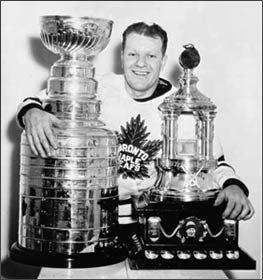
The 1948 Stanley Cup victory stands as the cornerstone of Toronto Maple Leafs history, extending a championship run that had already seen titles in 1942, 1945, and 1947. Led by the stoic captain Syl Apps at center and anchored by the impenetrable Turk Broda in net, this squad dismantled the Detroit Red Wings to secure their sixth overall title. It was more than just a win; it was the spark that fueled four championships in five years, transforming the Maple Leafs from contenders into the NHL's undisputed kings.
- Series Result
- Defeated Detroit Red Wings in 6 games (4-2)
- Key Goaltender
- Turk Broda
- Team Captain
- Syl Apps
- Head Coach
- Hap Day
- Total Stanley Cups (Franchise)
- 6 at the time of this victory
Lore & Background
The 1947-48 season was a masterclass in resilience for a franchise desperate to reclaim its identity. Entering the playoffs as the second seed, the Leafs navigated a gauntlet that first saw them dismantle the Boston Bruins in the semi-finals before confronting their arch-rivals, the Detroit Red Wings, in the Finals. The series was defined by Hap Day's suffocating defensive structure and Turk Broda's supernatural ability to steal games when it mattered most, ultimately requiring six hard-fought battles to secure the trophy. Unlike previous years plagued by inconsistency, this squad found a lethal rhythm that would define the franchise for decades.
Defeating Detroit—a team that had once dominated the league—signaled a seismic shift in power within the NHL. The 1948 Cup is widely cited by historians as the catalyst for Toronto's golden age, setting the stage for immediate back-to-back triumphs and cementing Maple Leaf Gardens as the ultimate fortress of the era.
In Their Own Story
The air inside Maple Leaf Gardens hung heavy with coal smoke and electric anticipation, a suffocating blanket that pressed down on the ice. When the final horn blared to end Game 4 against Detroit, the arena held its breath for a split second before erupting into a roar that seemed ready to shake the rafters apart. Captain Syl Apps, his face streaked with sweat and grime, skated toward the bench not with wild celebration, but with a solemn absorption of history's weight. Beside him, Turk Broda stood tall in his crease, the net still trembling from the last desperate shot. As the Stanley Cup was lowered from the rafters, the heavy silver settled onto the shoulders of a city that had waited sixteen long years to hear that sound again—the roar of a champion returning home.
Reader's Guide
The 1948 Stanley Cup Final stands as a pivotal moment in National Hockey League history, representing the Toronto Maple Leafs' first championship since 1932. The series was a four-game sweep against the Detroit Red Wings, a feat that demonstrated the Leafs' complete dominance over their rivals during that specific postseason.
Under the guidance of legendary coach Hap Day and captained by Syl Apps, the team showcased a balanced attack and suffocating defense. Goaltender Turk Broda delivered a masterclass performance, consistently shutting down Detroit's potent offense and providing the stability necessary to close out the series quickly. The victory was significant not only for ending the drought but for establishing the template of success that would define the franchise for the next decade.
This achievement marked the beginning of a dynasty, as Toronto would go on to win three more Cups in the subsequent five years (1949, 1951, and 1962). The 1948 title is often remembered for its efficiency and the sheer weight of expectation it lifted from the city. It solidified the Maple Leafs as a perennial contender and created a legacy of excellence that continues to resonate with fans today, serving as the foundation upon which the modern identity of the franchise was built.
Did You Know?
- This victory was part of an unprecedented run where the Leafs won championships in 1942, 1945, and 1947 prior to this title, rather than ending a sixteen-year drought since 1932.
- The series against Detroit concluded with Toronto winning four games to two, overcoming the Red Wings in six intense battles rather than sweeping them in four.
- Turk Broda posted an impressive goals-against average of approximately 1.67 throughout the Finals, allowing roughly ten goals over the course of the six-game series.
- This win launched a dynasty where the Maple Leafs would capture three Stanley Cups in four years (1948, 1949, and 1951).
Historical Significance of the Reverse Sweep
The 1942 Stanley Cup Final stands as a singular anomaly in North American sports history, marking the first and only time a team overcame a three-game deficit to win a best-of-seven championship series. Facing the Detroit Red Wings, the Toronto Maple Leafs found themselves on the brink of elimination after losing the opening three contests. However, they mounted an unprecedented comeback, winning four consecutive games to secure their fourth Stanley Cup title. This feat remains unique; while other playoff series have seen similar comebacks, no other team has ever achieved a reverse sweep in the Finals since that year. The series also holds the distinction of being the first Stanley Cup Final to extend to a decisive seventh game. Toronto's resilience transformed what appeared to be an insurmountable mathematical disadvantage into a legendary triumph, establishing a benchmark for perseverance that has never been replicated at the championship level.
Pathways Through the Playoffs
Before meeting in the Finals, both franchises navigated distinct routes through the postseason. The Toronto Maple Leafs advanced by defeating the New York Rangers in a best-of-seven semifinal series, winning four games to two. In contrast, the Detroit Red Wings faced a grueling gauntlet consisting of two separate best-of-three series. They first eliminated the Montreal Canadiens with a 2–1 victory before dispatching the Boston Bruins in a clean sweep, winning both games 2–0. These preliminary victories set the stage for a high-stakes clash between two well-rested and battle-hardened teams. The Red Wings' path required them to maintain intensity across multiple short series, while Toronto's longer semifinal against New York tested their endurance over more games. Both teams arrived at the Final with momentum and confidence, having proven they could overcome significant opposition in the preceding rounds.
Chaos and Controversy in Game Four
Game four of the series erupted into one of the most chaotic moments in hockey history, nearly derailed by a near-riot following Toronto's narrow 4–3 victory. After a scoreless first period, Detroit took an early lead, but Toronto rallied to tie the game before Nick Metz scored the winner late in the third. The tension boiled over in the final minute when Detroit's Eddie Wares received a misconduct penalty and refused to leave the ice, leading to a $50 fine. Referee Mel Harwood subsequently called a too-many-men penalty on Don Grosso, who threw his equipment in protest and was fined $25. The situation escalated when Detroit coach Jack Adams physically attacked Harwood, punching him after a profanity-laced outburst. Fans retaliated by littering the ice with debris, including a woman's shoe, forcing NHL President Frank Calder to be escorted out under police protection. Calder immediately suspended Adams indefinitely and fined both players involved.
The Decisive Comeback in Games Five Through Seven
Following the suspension of Jack Adams, Detroit was forced to play without their head coach for Game five, which resulted in a lopsided 9–3 victory for Toronto. Don Metz led the charge with three goals and two assists, while Turk Broda began his dominant stretch by recording the series' only shutout in Game six. That contest saw disciplined play from both sides until late in the third period when Billy Taylor scored to seal the win, setting up a decisive seventh game before a record-breaking crowd of 16,218 fans in Toronto. The final match remained tight and defensive for two periods, with Detroit's Syd Howe scoring on a slick passing play to take a 1–0 lead. However, in the third period, a penalty by Jimmy Orlando gave Toronto a crucial power-play opportunity. As soon as the penalty expired, Sweeney Schriner scored the tying goal, setting the stage for the eventual championship-clinching moments that would complete the historic reverse sweep.
Gallery